




If you’re based in the US, you won’t be able to process Polymarket payouts. Sorry to break it to you, but despite some of the info you’ve been getting, Polymarket isn’t available to Yanks. At least not yet.
However, Polymarket US is. It’s the Polymarket product built for US traders, so that’s where you should be playing. This guide offers all the deets you need to know about how payouts work there. I’ll set the context for the conversation by describing how both products differ. Then I’ll walk you through the contract resolution and settlement processes.
Quick facts about how payouts work at Polymarket US
- Polymarket US is a different product from Polymarket.
- It is CFTC-regulated and runs on a centralized, fiat-based architecture.
- At the time of writing, you can’t trade on politics, economy, weather, culture, or crypto (such as Solana prediction markets)
- You can receive your payouts via credit/debit cards, ACH Bank Transfer, and Apple Pay.
- Polymarket Clearing resolves and settles event contracts at Polymarket US.
Understanding how Polymarket works for US traders
So most US traders have got the whole Polymarket thingy mixed up for the longest; it’s easy to see why. Some years back, we (you and I) could trade event contracts on Bitcoin prediction markets on Polymarket wherever we liked in the US. Then sometime in 2022, the site got tons of flak from the Commodity Futures Trading Commission (CFTC), got fined $1.4 million, and eventually left the US. That was about the time the site shut its doors to US traders and totally became unavailable to us.
Here’s where it all gets interesting. Sometime in 2025, the CFTC changed its stance on event contracts, and about the same time, Polymarket acquired QCX LLC, which had become CFTC-regulated. With its acquisition of QCX LLC, Polymarket got a shot at getting back into the US prediction markets space. All it had to do was integrate infrastructure into QCX LLC's existing models, and voila!, we got a rebranded Polymarket site called Polymarket US.
So what does my history lesson have to do with Polymarket payouts? Well, everything. Polymarket and Polymarket US are two distinct products that have similar brand names. Here’s what I mean.
You still won’t be able to access Polymarket from the US because of regulatory restrictions, so no deposits, no trades, and of course no payouts. However, US traders can deposit, trade, and potentially get payouts on Polymarket US. I’ll unpack both products in the table below:
| Polymarket | Polymarket US |
| It’s an international brand and not available to US traders | Only available to US-based traders |
| It’s crypto-based and runs on blockchain technology | It’s fiat-based (US dollars) |
| Not CFTC regulated | CFTC-regulated |
| Available on PC and native app | Currently only available on the iOS app, but there’s talk about an imminent Android app |
| Doesn’t require Know Your Customer (KYC) checks to use. | Requires strict KYC checks before using it. |
| Covers multiple event categories, including sports, politics, economy, weather, culture, and crypto (such as Ethereum prediction markets) | Currently only offers sports prediction markets (NFL, NBA, NHL, Tennis, and golf, among others). However, there’s also talk of politics, finance, culture, and economics categories coming soon. |
In case you missed it, both products are powered by different payment systems (cryptocurrency vs. fiat). So, ultimately, payouts work differently at both sites. But before I get into how payouts work at Polymarket US, let’s have a quick look at how event contracts are traded at the site.
Here’s how trading works at Polymarket US
Polymarket US basically works as a designated contract market (DCM) and a derivatives clearing organization (DCO). Its available markets are presented as “Yes’’/”No” questions about the likelihood of an event occurring. I’d really like to be able to trade on 5-minute crypto prediction markets or Ethereum prediction markets but at the moment, only sports prediction markets are available.
Similar to Polymarket, at Polymarket US, each contract is priced between $0 and $1, with each contract price showing what other folks on the market think about the likelihood of an event occurring. So, let’s say that the “Will the Kansas City Chiefs win Super Bowl LX?” contract is priced at $0.55.
What that means is that other traders believe that the Kansas City Chiefs have a 55% shot at winning the Super Bowl LX. If you buy this contract and the outcome occurs, your contract settles at $1. If it doesn’t, the contract settles at $0.
Now that that’s out of the way, let’s get to how you get your payouts if your predictions come correct.
How Polymarket payouts work
As I already mentioned earlier, Polymarket is crypto-based and runs on the decentralized blockchain network. On the flip side, Polymarket US is fiat-based and is powered by a centralized system that makes it easy for the CFTC to keep an eye on. It took me some time to wrap my head around how payouts work at Polymarket US, but I finally did, and I’ll try to spell it out in plain speak. Let’s start with how contracts are resolved.
Contract resolution at Polymarket US
Before you receive payouts for your contracts with correct outcomes, the contracts have to be resolved. Now, there are no Polymarket oracle settlement criteria to be met at Polymarket US. That’s because it doesn’t use the UMA Optimistic Oracle used for contract resolution at Polymarket. Rather, it resolves and settles its available markets through Polymarket Clearing, which is a CFTC-regulated DCO. This is done using different sources at the following levels:
- Primary source: The primary source of the event is the official governing body or organization responsible for the event.
- Secondary sources: Let’s say there are no primary sources for the market; Polymarket US draws data from press releases, official competition scorecards, results databases run by the governing body, or reports from the referees or umpires.
- Tertiary sources: If the two sources above aren’t available, the site might get real-world data from reputable news sources like ESPN, Reuters, BBC Sport, the Associated Press, leading sports wire services or official team and league websites. So instead of using Polymarket smart contract resolution processing mechanisms, Polymarket Clearing does all the contract resolution based on CFTC regulations. That’s not all it does, though. It’s also responsible for settling event contracts at Polymarket US.
Contract settlement at Polymarket US
Polymarket US contracts are fully collateralized, and Polymarket Clearing acts as the central counterparty for each position on a trade. In plain speak, that means that both traders must have the cash required to cover a potential loss before a trade is completed. That way, there are enough funds locked so you can get the maximum Polymarket payout if the trade’s executed.
How does collateral work with event contracts? It’s about to get more technical and a tad boring if you’re not one for figures, but I’ll try to keep it simple.
Basically, when a trade goes through at a stated price, the buyers pay the contract price, and no additional margin is needed. In this position, the maximum loss is the amount paid, and the maximum gain is the amount at settlement minus the amount paid ($1.00 – amount paid).
Sellers on the other side of the trade receive the contract price as proceeds and post the $1.00 margin per contract (full payout value). The fiat balance goes up based on sales proceeds, and the buying power decreases (payout value – sale price). Here, the maximum loss is $1.00 – sale price, and the maximum gain is the sale price.
Contract settlement example
I’ll try to make things simpler with an illustration:
Let’s say the seller’s contract settled at $0.30; with the event not occurring, the seller keeps $0.30 in proceeds and releases a margin of $1.00. The total return for this side is $1.30, and the trader would have a net profit of $0.30.
If the event occurs, the seller’s $1.00 margin is paid to the buyer. They then keep $0.30 in proceeds but have a net loss of $0.70.
Once a trade is executed, the maximum gain and loss are fixed even if there are changes in the contract prices. After the contract is settled, Polymarket Clearing automatically releases the funds. If your prediction was spot on, you’ll bag a $1.00 payout per contract. You’ll get $0 if your prediction was off the mark.
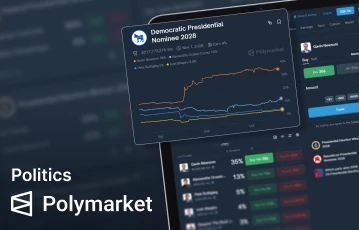
Make political predictions with Polymarket
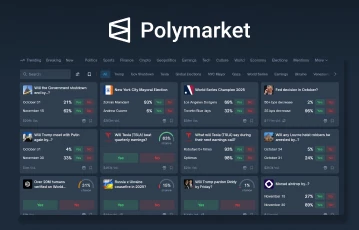
Polymarket has many prediction markets
How long do Polymarket payouts take
The length of time taken to get your payouts from Polymarket US depends on the payment method you use, and on average, it takes 3 business days tops. At the time of writing, the site supports ACH Bank Transfer through Aeropay. You could also use debit cards, credit cards, and Apple Pay via Checkpoint.com.
Based on my findings, you’d be able to receive your payouts through the same payment method that you used to fund your account. One more thing: since Polymarket US is fiat-based, it doesn’t support USDC-to-fiat payout solutions. Here are the deets on how to bag your payout at Polymarket US:
- Head over to the Payment section.
- Check for the withdrawal requirements of the available payment methods.
- Choose your preferred payment method.
- Enter the amount you’d like to withdraw.
- Review the details.
- Confirm the transaction to complete the process.
- Wait for the payout to be processed.
One more thing to keep in mind is that you’ll only receive your payout after it’s been cleared by the site.
Pros and cons of Polymarket payouts
Here’s the part of this guide where I walk you through the good and not-so-good sides of processing payouts at Polymarket US.
- CFTC-compliant processes
- Relatively fast
- No need for conversions
- Could be faster
Conclusion – Figuring out Polymarket payouts isn’t difficult
I’ll keep it a buck. It took me a minute to get my head around how payouts at Polymarket US worked, but it got easier over time. Polymarket Clearing is the main protagonist here as it handles contract resolutions and settlement instead of the automated blockchain processes at Polymarket.
The current payout system at Polymarket US is what’s available in the US, and it works. Rather well, if you asked me. It might take some getting used to, especially if you’re used to the old, pre-CFTC-beef Polymarket.
That said, this guide has laid things out square so you already know how the site’s system works. Did I mention that there’s on-app chat support? Well, there is, and the agents are more than willing to offer more guidance. If you’re still sitting on the fence about using Polymarket US, I think you should use it. One way to do that is to tap the on-page banners and follow the prompts.
Polymarket payouts FAQ
How are contracts resolved and settled before payouts at Polymarket?
The site resolves and settles its available markets through Polymarket Clearing, which is a CFTC-regulated DCO.
Do I have to pay fees for payouts?
Here’s the fun part. Polymarket US doesn’t charge transaction fees. But the payment methods you use might charge a processing fee.
What’s the Polymarket dispute settlement mechanism?
Polymarket Clearing is responsible for resolving and settling contracts on Polymarket US. Edge cases are handled using the official governing body results or the last fair market price.