




Thinking of where to trade different election outcomes? If you answer yes, this page is for you. Polymarket election markets provide tons of local and global political events, whose event contracts you can buy or sell, based on your sentiment.
I’ve traded a few political contracts, including those related to the posts of the Ethiopian prime minister and the Peruvian president. And with the US midterms coming up in a few months, I thought it best to share some key insights. Below, I’ll explain how these markets work, how to read Polymarket candidate shares, and share a few helpful strategies.
3 key facts about trading election markets on Polymarket
- Polymarket election markets let you purchase Yes or No event contracts on outcomes of local and global elections.
- Contract prices shift due to major political news and changes in traders’ views on this prediction market platform.
- The operator has 500+ active contracts for the upcoming 2026 US midterms, including individual Senate and gubernatorial races across multiple states.
An introduction to Polymarket election markets
Before I go any further, let me fill you in on how Polymarket works. It’s a decentralized prediction market platform where traders buy and sell event contracts on real-world events, including politics and elections.
The Polymarket election markets are one of the best to trade in the US. Every election market asks a question tied to an upcoming political outcome.
Here’s one I found on Polymarket: Will Mary Peltola win the Alaska Senate race in 2026?
Then, the market presents a Yes and a No contract on that outcome. Now, depending on your preference, you can purchase either event contract. Each is priced between $0.01 and $0.99. So, there’s going to be a winning outcome and a losing one.
If you trade a contract that ends up being a winning outcome, it settles at $1. Likewise, if you trade a contract that eventually loses (that is, your prediction was wrong), that contract resolves at $0.
Surely, you’re getting the hang of it. Now, back to the question of Mary Peltola winning the Alaska Senate race. Here’s the current price of the event contracts:
- Yes: $0.70
- No: $0.30
The Yes contract at $0.70 indicates that active Polymarket traders believe there’s a 70% chance that Peltola will win the Alaska Senate race. On the flip side, the NO contract is $0.30, which means participants believe there’s a 30% chance that Peltola won’t win.
Interestingly, these contract prices don’t sit still. It shifts based on current sentiment, news cycle, when a trader buys or sells, or anything else that could shape that political outcome in the real world.
To further show you just how serious this prediction market is, let me take your mind back to the 2024 US presidential race. Polymarket recorded over $3.3 billion in contract volume, making it the largest prediction market event ever recorded on the platform. So, predicting an election is more than just a random X (formerly Twitter) poll, where you’re simply guessing and having fun. Here, everyone is putting their money where their mouth is.
How to read Polymarket candidate shares
Reading Polymarket candidate shares is very easy. They’re simply event contracts priced between $0.01 and $0.99, representing the implied probability of that specific outcome occurring.
I understand that the Alaska Senate race contract I discussed earlier is still fresh on your mind. But, here’s another example to buttress my point:
Who will be the Maine Senate Election Winner?
- Democrat: Yes for $0.60, No for $0.40
- Republican: Yes for $0.40, No for $0.60
Now you’ll notice that these are US parties, not candidates. Well, in this election prediction market, a candidate is considered to represent a party if they are that party’s nominee. Right now, the market is saying there’s a 60% probability that a Democratic candidate will win the Maine Senate race.
On the other side, the Yes contract for the Republican candidate is priced at $0.40. It reflects a 40% probability of them winning. Interestingly, both sides usually sum to $1 (or 100%).
So, let’s say you follow the market’s narrative and trade the Yes contract for Democrats to win ($0.60) with $1,000. That means you’ll get ~1,667 shares. If the Democrats win, each Yes contract settles at $1, which gives you a total of $1,667 (a potential $667 profit). But if they don’t win, your contract settles at $0, and you’ll lose your funds.
One thing you may find surprising is that Polymarket operates on a peer-to-peer model. So, for every buyer, there is a seller willing to sell their event contracts. You’ll find this structure when trading in any other category, such as the Polymarket crypto markets or its sports markets.
The most active Polymarket election contracts in 2026
Right now, the Polymarket election markets are fully focused on the November 2026 midterms, which are less than five months away. The platform currently hosts over 500 active markets ahead of this key midterm election category. Here’s a breakdown below:
| Market type | Number of events | Example contract |
|---|---|---|
| Senate control | 35 | Who will be the Iowa Senate election winner? |
| House control | 435 | Who will be the WI-01 (Wisconsin’s 1st Congressional District) House election winner? |
| Gubernatorial races | 36 | Will the Republicans win the 2026 Kansas gubernatorial election? |
| Balance of power | 5 | Will there be a Democratic sweep (control of both the US House of Representatives and the Senate) ahead of the midterms? |
| 2028 futures | 30+ | Will JD Vance win the 2028 US presidential election? |
As you can see, there’s no shortage of contracts to dig into and no shortage of angles to explore. These events are the ones I found available at the time of writing. Feel free to check the platform for the updated number of events for your preferred market.
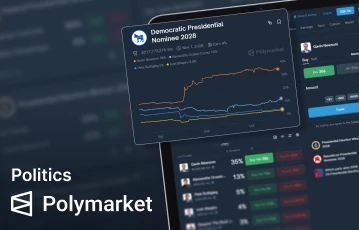
Predict the next election outcome at Polymarket
Mobile predictions made easier at Polymarket
How to trade Polymarket election markets
Here’s how to trade election markets on this platform.
- First, click the banners on this page, which will take you to the Polymarket app download page or the brand’s official website.
- Get a personal crypto wallet that’s compatible with the Polygon network and can hold USDC (USD Coin).
- Sign up on the Polymarket app or website using your crypto wallet. Alternative sign-ups include signing up with your email address or via Google.
- The operator will require you to verify your identity by submitting specific documents, such as your driver’s license or passport.
- Once you’re verified, log in to your Polymarket account.
- Go to the cashier section to make a deposit from your crypto wallet. The minimum deposit amount is $2. If you don’t have crypto, the platform offers a third-party payment service like MoonPay that lets you purchase USDC and transfer it to your account.
- Once your deposit is confirmed, click Polymarket’s Election sub-category.
- Choose a prediction market you’re interested in.
- Click the Yes or No event contract of your preferred election prediction market. Enter the amount you want to purchase, then finalize the transaction.
-
After purchasing your contracts, you have two options:
- Sell the trade if the price moves in your favor and ends up in a profit. You can also sell to mitigate a loss if your prediction is not going as planned.
- Hold your trade contract until the election occurs and the results are declared.
- If you hold and your prediction is right, you’ll get a payout of $1 per contract.
That’s basically it. I noticed that it was the same process for trading the Polymarket 5 minute Bitcoin (BTC) market. Just that, instead of the Elections sub-category, click the crypto category and filter the BTC market event by 5 minutes. It’s a completely different kind of experience compared to the long-dated political contracts I’ve been talking about.
Tracking election data on Polymarket
Now that you know how to trade Polymarket election markets, it’s time to track the data. As someone who spends time on this platform, I noticed that the market continually updates its view of developments during election periods.
Keeping that in mind, here’s how I approach it day by day:
- I sort the US Midterms page by 24-hour trading volume first. That tells me where the active money is focused right now, so I can make a move quickly.
- I then compare the platform’s implied probabilities against major poll aggregate averages. If there’s any major difference between the two, it means either the market knows something the polls haven’t caught on to yet. And that’s a good opportunity to position myself.
One thing I’d like to point out is that prediction market platforms have faced scrutiny related to insider trading. This means participants have early access to non-public information. Polymarket, in particular, has dealt with several high-profile cases.
For example, there was suspicious pre-announcement trading volume for predictions regarding the removal of Venezuelan leadership. This led to calls for investigations by US lawmakers. Another was that of a trader who made nearly $1 million from dozens of well-timed Polymarket trades that correctly predicted the US and Israeli military against Iran. The problem? These events, which this individual predicted, were unannounced military operations.
Thankfully, Polymarket has cooperated with investigations and taken action against traders found to have violated its rules. There’s no need to worry here; I just thought I’d let you know before you get started.
4 strategies for trading politics on Polymarket
There’s no total guarantee that you’ll win every time you trade on Polymarket election markets. However, there are four strategies I rely on most, which have given me an edge. They include:
🔍 Hunt for major poll news
Set alerts for major poll releases in competitive races. When a significant number drops, check the price of the relevant Polymarket contract immediately. If it hasn’t moved yet, that’s your window of opportunity. As such, you get in cheap. So, when the market eventually catches up, you’re already sitting on a potential gain.
📈 Trade around narrative events
If you’re familiar with the phrase ‘trading the news,” well, you’ll see a lot more of it in Polymarket election markets. They respond aggressively to even the tiniest narrative shifts. A debate stumble, an endorsement from a major national figure, or an unexpected campaign development can create sharp price action.
So the strategy here is to position yourself early into a high-probability event or get in during the first hour after something major breaks. Miss that window, and you may have to wait for another development, which can take a few days.
🔗 Spread across correlated markets
Rather than go all in on who controls the Senate event contract, I try to diversify my risk. I could look across individual competitive state races and find the ones where that party’s contract is priced more cheaply. Then I buy into five to eight of these contracts. That way, I smooth out the risk of any single race surprising me at the end of the day.
💰 Take profits early when you’re ahead
Profit is profit, and it can take a while for you to actually internalize that. It was the same for me. It can be very tempting to hold a contract just to see it through to the end ($0 or $1). But as I mentioned, there’s no 100% guarantee on how an election outcome will turn out. Time and time again, I have seen politics prediction markets move from $0.90 to $0.00.
So, if I bought a contract at $0.20 a few weeks ago and it’s now trading at $0.70 with two months left to the US midterms, best believe I’m locking in that gain. Why? The market can shift at any time, and there’s no true profit until you press the sell button. I understand every trader is different in this aspect, but this approach lets you take several trades before the major elections even begin.
Pros and cons of Polymarket election markets
To finalize my discussions on Polymarket election markets, here are some pros and cons worth noting.
- US and global elections are supported
- Simple Yes/No setup
- Flexibility to hold or sell your event contracts
- In-depth research is needed before placing a trade
- Crypto wallet setup may be difficult for non-crypto users
Sign up on Polymarket and lock in your position ahead of the upcoming major elections
Polymarket election markets are among the best out there and worth exploring. Right now, there are 500+ markets on the upcoming 2026 midterms, featuring event outcomes on who will win the Senate, House, and governorship races in individual states.
Of course, there’s never a guarantee in the election market. That’s why I have prepared your mind on how to position yourself on this page. Now, I’m heading back to the platform to check out a few election contracts. If you’re interested, consider the strategies above and click the banners on this page to set up your Polymarket account right away.
Polymarket election markets FAQs
What is a Polymarket election contract?
A Polymarket election contract is a Yes/No outcome linked to a specific political event, usually priced between $0.01 and $0.99. The price reflects the market’s current implied probability of that outcome. If you purchase the winning side, your contract settles at $1.00. If your prediction is incorrect, it settles at $0.00.
Is it legal to trade Polymarket election markets in the US?
Yes. Polymarket operates under federal oversight by the United States Commodity Futures Trading Commission. As such, its election prediction markets are available across 50 US states (plus DC). However, access may vary by jurisdiction. So review your state’s rules regarding election trading before getting started.
How are the US presidential election Polymarket probabilities different from traditional polls?
Polls are static snapshots collected at a single point in time. On the other hand, Polymarket’s implied probabilities update continuously as traders react to new information with real money on the line. This financial accountability means the market tends to respond to breaking news faster than traditional polling.
Can I exit a Polymarket election contract before the event resolves?
Yes. You can sell your position at any time before the market settles. For instance, if you purchased a contract at $0.34 and the price has since moved to $0.71, you can take that gain off the table without waiting for election night. On the other hand, if the price moves towards $0.15 after purchasing the contract, you can exit the trade to minimize potential losses.