




Cryptocurrency price movements are among the most exciting places for prediction markets. Luckily, Polymarket crypto markets seem to be a great place to start, especially if you enjoy following which ones are volatile.
If crypto's moving, chances are, there's a market for it at Polymarket. In this guide, you’ll learn how the site works, how to trade crypto event markets, the contract types you should expect here, and how you can confidently place your first trades while avoiding beginner mistakes. Continue reading through my guide to learn more and enjoy your experience on the site.
What are Polymarket crypto markets?
Polymarket’s crypto section lets you trade where cryptocurrency prices could go next without having to buy a single coin. You’ll find everything from short-term price movements to long-term price targets.
Understanding crypto prediction markets
Fancy calling Bitcoin's next move without buying any Bitcoin? That's exactly what these markets let you do. Instead of buying BTC or ETH, you buy Yes or No shares based on whether you think a stated outcome will occur. Share prices reflect the crowd’s opinion, so a Yes share trading at $0.70 suggests around a 70% chance of that event happening. Once the contract reaches its expiry or its conditions are met, it settles based on the official resolution source. Get the call right, and your winning shares settle at $1 each. Miss it, and they're worth nothing.
How crypto markets differ from traditional crypto trading
Normally, you buy and sell coins in the hope that their value increases over time. Polymarket crypto markets are a whole different ball game. Instead of owning cryptocurrencies, you trade the outcome of specific events. Ethereum prediction markets, for example, track whether ETH finishes above a certain price or rises over a specified period. Every contract has a binary outcome, which is Yes or No, and settles according to its published rules. Because markets last anywhere from minutes to months, you can focus on forecasting events rather than sitting around waiting for prices to appreciate.
How Polymarket organizes crypto markets
The crypto section on Polymarket is laid out to help you get straight into different markets. Instead of scrolling through dozens of contracts, you can filter by market type, expiry period, or cryptocurrency. This means less scrolling and more time spotting markets you actually want to trade.
🔍 Browsing the Crypto category
Polymarket groups every cryptocurrency contract into one place. I like that you can filter by contract type to separate markets. All displays every available market, while Up / Down focuses on directional price movement. Above / Below lets you browse contracts based on price thresholds, Price Range groups markets predicting where an asset will finish, and Hit Price shows contracts asking whether a cryptocurrency will reach a specific target before a deadline.
⏳ Using time filters to find markets
Polymarket also organizes contracts by expiry time. You can browse 5 Minute, 15 Minute, 1 Hour, 4 Hours, Daily, Weekly, Monthly, and Yearly markets from the sidebar. Short-duration contracts like Polymarket 15 minute contracts are perfect if you like playing the bigger picture and closely following live price action. Longer expiries are better if you prefer reacting to broader market trends, major news, or long-term forecasts.
💱 The different cryptocurrencies you can trade
The Crypto section includes markets for several well-known assets. I spotted Bitcoin, Ethereum, Solana, XRP, Dogecoin, BNB, and even MicroStrategy, whose share price is closely tied to Bitcoin. Selecting one of these asset filters shows only relevant contracts. If you’re interested in a single cryptocurrency, unrelated markets are masked, meaning you can compare every opportunity much faster than before.
🔎 Using search and market filters
When hundreds of contracts are available, the search tools really come into their own. The search bar helps you jump directly to a specific market or cryptocurrency, while category filters narrow the results even further. You can also save markets to highlight the contracts you always go back to, making it easier to focus on your specialties. Overall, these navigation tools cut through the noise and help you find the right contract without having to scroll through every live market.
Understanding the different crypto contract types
I found a wide range of Polymarket digital asset contracts, each all about a different prediction. Some focus on whether a coin moves up or down, while others ask whether it reaches a price target or finishes within a specific range. Once you know how each market works, spotting opportunities becomes much easier.
Up or Down markets
Up or Down markets are the easiest contracts to understand on Polymarket. You predict whether an asset will finish above or below its starting price at expiration. These markets are available over multiple time frames, including fast-paced 5-minute contracts and longer daily markets. Every contract includes a countdown timer showing exactly how much time remains before settlement. Since these are live markets, prices never really sit still. Every headline, big trade, or sudden pump can shift the probabilities within seconds.
Above or Below markets
Above or Below markets ask whether a cryptocurrency will finish above or below a specified price threshold. Instead of predicting direction alone, you’re forecasting whether the asset is at a defined level before the contract resolves, depending on its published rules. You’ll often see several strike prices for the same asset, allowing you to compare more conservative and more ambitious targets. Picking realistic price targets based on current market conditions can help you find contracts that better match your outlook.
Price Range markets
Price Range markets require you to predict where a cryptocurrency will finish within a set group of price bands. Rather than selecting a simple Yes or No outcome, you compare multiple possible closing ranges. For example, the hottest contract I found while checking out Polymarket crypto markets asked whether Bitcoin would finish between $110,000 and $112,000 by the end of the day. Markets closer to the current price often carry higher implied probabilities than more distant ranges, although prices change as trading activity increases.
Hit Price markets
Hit Price markets focus on whether a cryptocurrency reaches a specific price target before a stated deadline. Whether it then falls right back down doesn’t matter one bit, as long as it has reached the target. You’ll commonly find weekly and monthly contracts with several target prices available for the same asset. Higher targets usually offer lower probabilities, while more achievable levels often trade at higher prices. If the target is reached according to the market rules, the contract can be immediately resolved. Otherwise, it stays live until the deadline, when it settles based on whether the target was achieved.
Polymarket token launch markets
Polymarket token launch markets focus on events surrounding new cryptocurrency launches rather than day-to-day price movements. Depending on what’s available, you may find contracts asking whether a token will launch before a certain date, list on a major exchange, or meet another clearly defined milestone. These markets often depend on official announcements from project teams, exchanges, or blockchain networks, so always read the resolution criteria carefully.
| Contract type | What you predict | Example | When the market resolves |
|---|---|---|---|
| Up / Down | Whether the asset finishes higher or lower than the starting price | BTC Up in the next 15 minutes | At the contract expiry time |
| Above / Below | Whether the asset reaches or stays above/below a specified price | Ethereum above $1,700 | At the stated expiry or according to market rules |
| Price Range | In which price range does the asset finish | Bitcoin between $58,000–$60,000 | When the specified period ends |
| Hit Price | Whether the asset reaches a target price before the deadline | Bitcoin hits $100,000 by December 31 | As soon as the target is hit or when the deadline expires |
| Token Launch | Whether a token launch or launch-related milestone occurs before a specified deadline | A new token launches before September 30 | When the milestone is officially confirmed or the deadline expires |
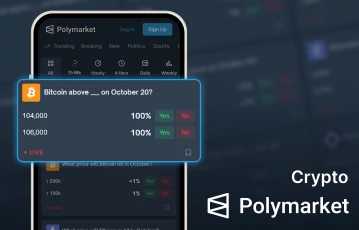
Trade crypto-based contracts at Polymarket
Explore more prediction markets at Polymarket
Reading a crypto market and executing a trade
Every Polymarket contract includes the information you need before placing a trade. From price charts and countdown timers to market rules and trading controls, each section helps you understand how the contract works. As such, taking a few moments to review the page can help you avoid mistakes and make more informed trading decisions.
1. Understand the price chart
The price chart shows how the market’s implied probability has changed over time. You can view historical movement in a selected timeline to see the recent trading crypto trends on Polymarket and how trader sentiment has shifted. Alongside the chart, you’ll typically find the current Yes and No prices, recent trading volume, and a countdown timer showing exactly when the market will expire. Put it all together, and you'll quickly see whether the market is buzzing or barely moving.
2. Review market rules
Before buying shares, I always take a minute to read the market rules. These rules explain the exact resolution conditions, the data source used to determine the outcome, and when the contract will settle. Many crypto markets also state which exchange provides the official price data used for settlement. Small details, such as how prices are measured or the precise expiry time, can affect the final outcome. Understanding the rules first helps you avoid entering a market based on incorrect assumptions.
3. Understand the trading controls
The trading panel is designed to keep placing orders nice and simple. You can choose to buy or sell shares, select either the Yes or No outcome, and enter the amount you want to trade. Depending on market conditions, you may also have the option to place market orders, which execute at the best available price. Before confirming, you also need to confirm the estimated fees and potential payout, then use the trade button to submit your order.
4. Additional market information
Besides the trading tools, Polymarket provides several features that add useful context. The Comments section lets traders discuss news and market sentiment, while Top Holders highlights accounts with the largest positions. If you’re interested in other event categories, such as Polymarket election markets, you’ll notice the same habit applies. I could also review Positions to track your open trades, browse the Activity feed to see recent transactions, and check Resolver information to understand who determines the official outcome.
How market pricing and probabilities work
Polymarket prices do more than show what traders are paying for shares. They also represent the market’s collective view of how likely an outcome is to happen. As fresh news drops and more people trade, both prices and probabilities adjust in real time to reflect changing expectations.
Probability percentage basics
Every market displays a probability based on the current price of Yes and No shares. For example, if a Yes share trades at $0.70, the market is estimating roughly a 70% chance of that outcome occurring. Put loosely, if there were 10 traders, each buying one share, this would mean 7 of them thought an event would happen, while only 3 predicted it wouldn’t. These percentages aren’t fixed. They move constantly as traders buy and sell shares in response to news, price movements, and changing sentiment.
Liquidity and trading volume
Liquidity refers to how easily shares can be bought and sold without causing large price swings. Active markets typically have higher trading volume and greater open interest, meaning more participants are buying and holding positions.
Going back to our previous example, if one trader suddenly came in and bought 20 No contracts, the price would immediately move from $0.70 to $0.35. That’s because there’d now be only 7 Yes shares to 13 No’s. The more people trading, the quicker the market reacts when big crypto news breaks. In less active markets, price movements may be wider when relatively small trades are executed.
What influences crypto prediction markets?
Crypto never sleeps, and neither do these markets. ETF news, exchange listings, whale moves, and even a viral tweet can send prices flying. A five-minute market is often driven by immediate price action. On the other hand, major developments in a certain industry directly influence long-term contracts. It goes without saying that understanding what typically moves each market type can help you interpret changing probabilities more effectively.
📈 Price action and volatility
Short-term markets are heavily influenced by price action and volatility. In contracts lasting just a few minutes or hours, traders often react to market momentum, technical moves, and rapid changes in buying or selling pressure rather than major news events. Investor sentiment can also shift quickly, leading to changes in probabilities as the underlying cryptocurrency moves. For longer-duration markets, these short-term fluctuations are usually just one part of the overall picture.
📅 Major crypto events
Longer-term contracts are more likely to be influenced by significant developments in the crypto industry. ETF approvals, exchange listings, token upgrades, and even regulatory headlines can send these markets into overdrive. These developments don’t always affect markets immediately, but they often influence weekly, monthly, or yearly contracts as traders reassess the likelihood of longer-term outcomes.
💭 Market psychology
Market prices also reflect how traders collectively view an outcome. Optimism can raise probabilities, while fear and uncertainty may reduce confidence even if little has fundamentally changed. Probabilities just then adjust to reflect the balance between buyers and sellers.
🌐 Different cryptocurrencies move for different reasons
Not every crypto market reacts to the same catalysts. Bitcoin often responds to macroeconomic trends, institutional demand, ETF developments, and broader investor sentiment, making it a benchmark for the wider market. Ethereum may be influenced by network activity and ecosystem growth, while Solana prediction markets frequently react to factors such as network upgrades, DeFi activity, new token launches, and increased on-chain usage.
Polymarket crypto markets pros & cons
Like any prediction platform, Polymarket has strengths and limitations. Understanding both can help you decide whether the crypto markets match your trading style and experience level.
- Wide range of crypto contract types and time frames
- Easy-to-use filters for quickly finding specific markets
- Transparent market rules and resolution criteria
- Some contracts may have lower liquidity than others
Place your first crypto trade on Polymarket
Polymarket crypto markets let you predict cryptocurrency price movements and other blockchain-related outcomes without buying the underlying assets. The event predictions platform organizes markets by contract type, time frame, and cryptocurrency, making it easy to find opportunities that match your interests.
Once you’ve chosen a market, understanding the contract rules, pricing, probabilities, and settlement process helps you trade with greater confidence. But before putting real money on the line, spend a little time learning how the different markets move. When you’re ready, click the banners on this page to sign up with Polymarket and start exploring its crypto markets.
Polymarket crypto markets FAQ
What are Polymarket crypto markets?
Polymarket crypto markets are prediction contracts where you trade on cryptocurrency-related outcomes instead of buying digital assets. Each market asks a specific question, such as whether Bitcoin will reach a price target or finish higher by a certain time. Your trade settles according to the published market rules once the event is resolved.
How do Up or Down markets work?
Up or Down markets ask you to predict whether a cryptocurrency will finish above or below its starting price when the contract expires. You buy Yes or No shares based on your prediction. Once the expiry time is reached, the market settles using the official resolution criteria listed on the contract page.
What happens when a crypto market resolves?
When a market resolves, the official data source determines whether the outcome is Yes or No. Winning shares pay out $1 each, while losing shares expire worthless. Every contract settles according to its published rules, ensuring all traders receive the same outcome based on the official resolution source.